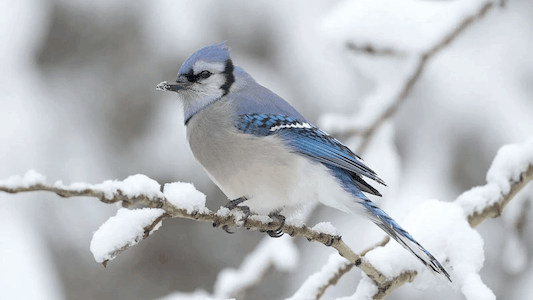

If you've ever sat on a porch in the eastern United States and heard a sharp, piercing jay! jay! cut through the morning air, chances are a Blue Jay was nearby — probably making sure everyone within half a mile knew it. These striking birds are among North America's most recognizable backyard visitors, and they're far more fascinating than their rowdy reputation suggests.
A Flash of blue in the canopy
The Blue Jay (Cyanocitta cristata) is hard to miss. Dressed in vivid shades of blue, white, and black, with a distinctive crest atop its head, it cuts a dramatic figure wherever it goes. The crest itself is a mood indicator — raised when the bird is excited or alarmed, relaxed when it's calm and feeding.
Despite the name, Blue Jays aren't actually blue in the way a blueberry is blue. Their feathers contain no blue pigment. Instead, the color is the result of light scattering through the microscopic structure of the feathers — a phenomenon called structural coloration. Crush a blue jay feather and the blue disappears entirely. It's a small reminder that nature loves an optical illusion.
More than just noise
Blue Jays have a reputation for being loud and aggressive, and honestly, they've earned it. They're known to mob predators — hawks, owls, even cats — with relentless alarm calls, diving and harassing until the threat retreats. This behavior, while annoying to some backyard birders, actually benefits the entire local bird community. When a Blue Jay sounds the alarm, every creature within earshot gets the warning.
Their vocal abilities go well beyond simple alarm calls. Blue Jays are accomplished mimics, capable of imitating the calls of Red-tailed Hawks and other raptors with surprising accuracy. Whether they use this skill to warn other birds or to clear competitors away from a feeder is still a matter of some debate among ornithologists — possibly both.
Surprisingly smart
Blue Jays belong to the family Corvidae, which includes crows, ravens, and magpies — a group widely regarded as the most intelligent birds on the planet. Blue Jays live up to this lineage.
They are dedicated food cachers, storing thousands of acorns and seeds each autumn to retrieve throughout winter. Studies have shown they can remember the locations of hundreds of these caches, a feat of spatial memory that puts most humans to shame. In fact, Blue Jays are considered one of the primary spreaders of oak trees across North America. They favor acorns, carry multiple at a time in a throat pouch, and often bury more than they retrieve — effectively planting forests as they go.
In captivity, Blue Jays have demonstrated the ability to use tools and show signs of self-awareness, further cementing the corvid family's reputation for avian intelligence.
Life in the flock
Blue Jays are monogamous and often mate for life. During courtship, small groups of males follow a female through the treetops in a slow, quiet flight — a surprisingly gentle behavior from such a boisterous bird. Once paired, both parents share duties in building the nest, incubating eggs, and raising the young.
Outside of breeding season, Blue Jays are highly social. They travel in loose family groups and communicate constantly through a complex repertoire of calls, clicks, and whistles. Researchers have identified numerous distinct vocalizations, and the birds appear to respond differently to each one — suggesting a rudimentary form of language.
A Common Bird Worth Noticing
Blue Jays are abundant across the eastern and central United States, extending into southern Canada. They adapt readily to suburban and urban environments, and a well-stocked bird feeder — especially one with peanuts or sunflower seeds — is almost guaranteed to attract them.
They're not a bird in decline, but that's no reason to take them for granted. The next time a Blue Jay lands on your fence and lets out a string of raucous calls, take a moment to watch it. Notice the crisp black necklace across its chest, the way it tilts its crest, the bold curiosity in its eye. Beneath all that noise is one of the most intelligent, ecologically important, and visually stunning birds in North America.
It just really wants you to know it's there.
Blue Jays can live up to 17 years in the wild, though most live closer to 7. The oldest known wild Blue Jay reached 26 years and 11 months.